

In the pharmaceutical industry, the precision and reliability of equipment are of utmost importance. A horizontal mixer plays a critical role in various pharmaceutical processes, from preparing active pharmaceutical ingredients (APIs) to blending excipients. This blog will delve into the special requirements for a horizontal mixer in the pharmaceutical industry, with insights from a horizontal mixer supplier.
Hygiene and Cleanability
One of the most crucial requirements for a horizontal mixer in the pharmaceutical industry is ensuring high - level hygiene. Pharmaceutical products need to be free from contaminants, whether they are microbial, chemical, or particulate. The design of the horizontal mixer must facilitate thorough cleaning.
All interior surfaces of the mixer should be smooth and free of crevices or corners where product residues can accumulate. Polished stainless - steel construction is commonly used as it is corrosion - resistant and easy to clean. Some advanced horizontal mixers feature a self - cleaning system, which can significantly reduce the time and labor required for cleaning. For example, the SLHY Horizontal Mixer is designed with a smooth interior that allows for easy washing and sanitization, minimizing the risk of cross - contamination between different batches of pharmaceutical products.
Moreover, the mixer should be able to withstand the use of strong cleaning agents and sanitizers. This means that the materials used in its construction must be resistant to chemical attack. Seals and gaskets also play a vital role; they need to be made of materials that can maintain their integrity during repeated cleaning cycles.
Precision Mixing
Pharmaceutical formulations often require a high degree of uniformity in mixing. Even a slight variation in the distribution of APIs or excipients can have a significant impact on the efficacy and safety of the final product. Horizontal mixers in the pharmaceutical industry need to have precise control over the mixing process.
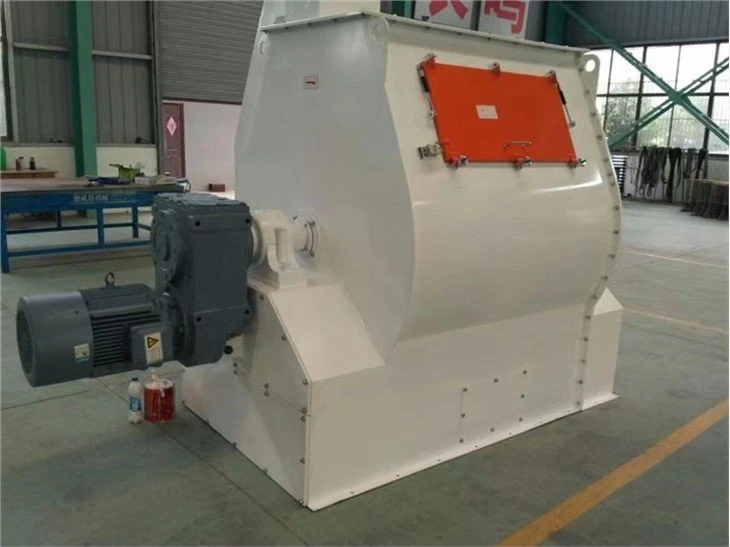

The mixer's agitator design is crucial for achieving uniform mixing. Paddle - type agitators are commonly used in horizontal mixers for pharmaceutical applications. The Feed Mill Paddle Mixer is an example of a mixer with well - designed paddles that can gently move the materials through the mixing chamber, ensuring that all particles are evenly distributed.
The speed of the agitator also needs to be accurately controlled. Different pharmaceutical formulations may require different mixing speeds. For some viscous materials, a slower speed may be needed to avoid excessive shear forces that could damage the product. In contrast, for less viscous materials, a higher speed can help achieve faster and more uniform mixing.
Containment
In the pharmaceutical industry, many APIs are potent substances, and exposure to them can pose risks to the health of operators. Therefore, horizontal mixers need to be designed with proper containment features.
The mixer should have a sealed enclosure to prevent the leakage of powders or dust during the mixing process. Advanced horizontal mixers are equipped with dust collection systems to capture any fine particles that may escape. Additionally, the loading and unloading ports of the mixer should be designed to minimize the release of materials into the surrounding environment.
The SJHS Paddle Mixer is designed with a high - quality sealing system and built - in dust control mechanisms. This ensures that the operator is protected from exposure to potentially harmful substances during the operation of the mixer.
Validation and Documentation
The pharmaceutical industry is highly regulated, and all equipment used in the production process must be validated. A horizontal mixer supplier needs to provide comprehensive validation documentation to prove that the mixer meets the required standards.
This documentation includes design qualification (DQ), installation qualification (IQ), operational qualification (OQ), and performance qualification (PQ). DQ ensures that the mixer is designed to meet the specific requirements of pharmaceutical applications. IQ verifies that the mixer is installed correctly, while OQ demonstrates that the mixer operates within the specified parameters. PQ shows that the mixer can consistently produce batches of pharmaceutical products with the desired quality.
In addition to validation documentation, the supplier should also provide detailed operation manuals, maintenance schedules, and spare parts lists. This helps pharmaceutical manufacturers to operate and maintain the mixer in a proper and compliant manner.
Compatibility with Different Materials
Pharmaceutical products can have a wide range of physical and chemical properties. Horizontal mixers need to be compatible with different types of materials, including powders, granules, and pastes.
For example, some pharmaceutical powders may be hygroscopic, meaning they absorb moisture from the air. The mixer should be able to prevent moisture ingress and maintain the stability of the powder during the mixing process. Granules may have different sizes and densities, and the mixer should be able to handle them without causing segregation.
A versatile horizontal mixer should be equipped with adjustable settings to accommodate different materials. This includes adjusting the speed of the agitator, the angle of the paddles, and the duration of the mixing cycle.
Scalability
As pharmaceutical companies grow and expand their production capacity, the horizontal mixer needs to be scalable. This means that the mixer can be easily adjusted to handle different batch sizes without sacrificing the quality of mixing.
A well - designed horizontal mixer should have a modular design, allowing for easy addition or removal of components to increase or decrease the volume of the mixing chamber. This scalability not only ensures the long - term usability of the mixer but also helps pharmaceutical manufacturers to optimize their production processes according to market demand.
Conclusion
In conclusion, a horizontal mixer in the pharmaceutical industry has several special requirements, including hygiene, precision mixing, containment, validation, compatibility with different materials, and scalability. As a horizontal mixer supplier, we understand these requirements and are committed to providing high - quality, reliable horizontal mixers that meet the stringent standards of the pharmaceutical industry.
If you are in the pharmaceutical industry and are looking for a horizontal mixer that can meet your specific needs, we encourage you to reach out to us for a detailed consultation. We have a professional team of experts who can help you select the most suitable mixer for your production process and provide comprehensive after - sales support.
References
- Bhandari, B. R., & Howes, T. (Eds.). (1999). Dehydration of foods: A comprehensive review. CRC Press.
- Nema, S., Khadka, S., & Chauhan, G. S. (2002). Pharmaceutical preformulation and formulation: A practical guide from candidate drug selection to commercial dosage form. CRC Press.
- Shah, V. P., & Shah, V. J. (2004). Handbook of pharmaceutical controlled release technology. CRC Press.