

The poultry industry has witnessed remarkable growth over the past few decades, with an increasing demand for high - quality poultry feed. A well - mixed feed is the cornerstone of healthy poultry growth, as it ensures that each bird receives a balanced diet containing all the necessary nutrients. As a leading poultry feed mixer supplier, I am excited to share with you the mixing principle of a poultry feed mixer.
The Importance of Proper Feed Mixing
Poultry, like all animals, have specific nutritional requirements at different stages of their growth. A balanced diet includes proteins, carbohydrates, fats, vitamins, and minerals in the right proportions. Improper mixing of feed ingredients can lead to nutritional imbalances, which may result in poor growth, low disease resistance, and reduced egg production in laying hens. Therefore, understanding how a poultry feed mixer works is crucial for poultry farmers and feed manufacturers.
Primary Mixing Principles
There are two main types of mixing principles commonly used in poultry feed mixers: convective mixing and shear mixing.
Convective Mixing
Convective mixing involves the movement of large groups of particles from one location to another within the mixer. This is typically achieved by the rotation of mixing elements such as paddles, screws, or ribbons. When the mixer is in operation, these elements push and pull the feed ingredients around the mixing chamber, creating a fluid - like movement.
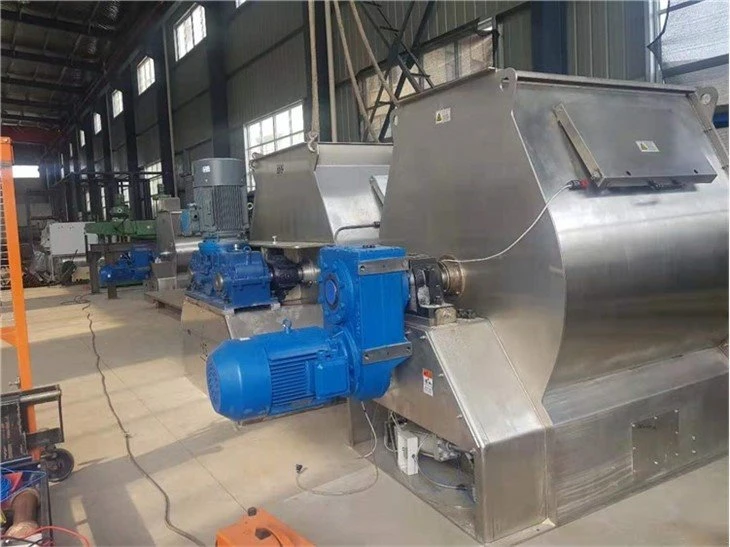
For example, in a Horizontal Mixer, the horizontal arrangement of the mixing shaft and the paddles allows for a horizontal flow of the feed materials. The paddles pick up the ingredients from the bottom of the mixer and move them to the top, then let them fall back down, continuously redistributing the materials throughout the chamber. This movement helps to spread the different ingredients evenly across the entire batch of feed.
The efficiency of convective mixing depends on several factors, including the design of the mixing elements, the speed of rotation, and the volume of the mixture. A well - designed mixer will ensure that all parts of the mixture are involved in the convective movement, minimizing the formation of unmixed pockets.
Shear Mixing
Shear mixing is the process of breaking down clumps of feed ingredients and distributing them more uniformly by applying a shearing force. This force is generated when the ingredients are forced to flow between two surfaces moving at different speeds.
In a poultry feed mixer, shear mixing often occurs at the edges of the mixing elements. For instance, when the paddles in a SJHS Paddle Mixer rotate, the feed particles near the paddle surface experience a different velocity compared to those further away. This difference in velocity creates a shearing action that breaks up agglomerates and promotes the dispersion of fine particles.
Shear mixing is especially important for dealing with ingredients that tend to clump together, such as molasses or some types of additives. However, excessive shear can also cause damage to the feed particles, so the intensity of shear mixing needs to be carefully controlled.
Additional Considerations in Poultry Feed Mixing
Batch Size
The batch size has a significant impact on the mixing process. A mixer that is overfilled may not be able to achieve proper mixing because there is not enough space for the ingredients to move freely. On the other hand, using a very small batch size in a large mixer can lead to inefficient energy use and inconsistent mixing results. It is essential to select a mixer with an appropriate capacity based on the production requirements.
Mixing Time
The optimal mixing time is another critical factor. Insufficient mixing time will result in an uneven distribution of ingredients, while over - mixing can be a waste of energy and may even cause degradation of some heat - sensitive nutrients. The mixing time is usually determined through experimentation and depends on the type of mixer, the nature of the ingredients, and the desired level of homogeneity.
Ingredient Characteristics
The physical and chemical properties of the feed ingredients also play a role in the mixing process. Ingredients with different particle sizes, densities, and flowability can affect how easily they mix with each other. For example, fine powders may tend to stick to the walls of the mixer or form dust clouds, while large particles may require more convective movement to be evenly distributed.
The Role of Advanced Features in Poultry Feed Mixers
Water Adding System Device
In some cases, it is necessary to add water to the feed mixture to improve its palatability and pelletability. A Water Adding System Device allows for the precise addition of water during the mixing process. This device can be programmed to add a specific amount of water at a certain stage of the mixing cycle, ensuring that the moisture content of the feed is consistent throughout the batch.
Automation
Many modern poultry feed mixers are equipped with automation features. Automated control systems can regulate the mixing speed, time, and the addition of ingredients, reducing the potential for human error. These systems can also provide real - time monitoring of the mixing process, allowing operators to make adjustments as needed to ensure high - quality feed production.

Achieving High - Quality Feed Mixing
To achieve high - quality feed mixing, it is important to perform regular maintenance on the feed mixer. This includes cleaning the mixer after each use to prevent the accumulation of feed residues, which can affecting the next batch's mixing quality. Inspecting and replacing worn - out parts, such as paddles or belts, in a timely manner is also crucial to ensure the proper functioning of the mixer.
In addition, analyzing the feed samples regularly can help to verify the quality of the mixing. By testing the nutrient content at different locations within the batch, farmers and feed manufacturers can determine if the feed is uniformly mixed and if any adjustments need to be made to the mixing process.
Conclusion
In summary, the mixing principle of a poultry feed mixer is based on convective and shear mixing, with additional considerations such as batch size, mixing time, and ingredient characteristics. Advanced features like water adding systems and automation can further enhance the mixing process and improve the quality of the feed.
As a poultry feed mixer supplier, we are committed to providing high - performance mixers that meet the diverse needs of the poultry industry. Our mixers are designed with the latest technology and engineering to ensure efficient and uniform mixing of feed ingredients.
If you are interested in our poultry feed mixers and would like to learn more about how they can benefit your poultry farming or feed manufacturing operation, please feel free to reach out to us for procurement and further discussions. We are always ready to offer professional advice and solutions to help you achieve optimal feed production.
References
- Poultry Science Association. (20XX). "Best Practices in Poultry Feed Manufacturing".
- Feed Industry Journal. (20XX). "Innovations in Feed Mixing Technology".
- European Feed Manufacturers' Federation. (20XX). "Guidelines for Quality Feed Mixing".