

In the industrial drying process, belt dryers have long been recognized as efficient and reliable equipment for a wide range of materials, from food products to feed ingredients. As a leading belt dryer supplier, I've witnessed firsthand the critical role that belt width plays in determining the drying capacity of these machines. In this blog post, I'll delve into the influence of belt width on the drying capacity of a belt dryer, exploring the underlying principles, practical implications, and considerations for optimizing performance.
Understanding the Basics of Belt Dryers
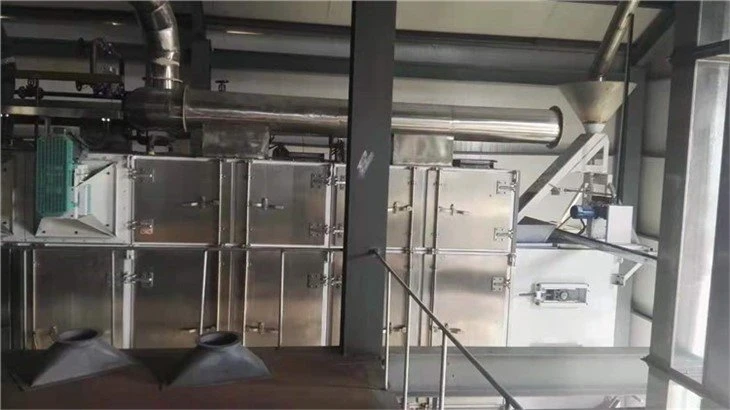
Before we dive into the impact of belt width, let's briefly review how a belt dryer works. A belt dryer consists of a conveyor belt that moves the material through a drying chamber. Hot air is circulated through the chamber, either by natural convection or forced ventilation, to remove moisture from the material. The drying process can be adjusted by controlling factors such as air temperature, airflow rate, and belt speed.
The drying capacity of a belt dryer is typically defined as the amount of moisture that can be removed from the material per unit of time. This capacity is influenced by several factors, including the type of material being dried, the initial moisture content, the desired final moisture content, and the design and operating parameters of the dryer itself. Among these factors, belt width plays a crucial role in determining the overall drying capacity.
Influence of Belt Width on Drying Capacity
The relationship between belt width and drying capacity is relatively straightforward: a wider belt can accommodate more material, allowing for a higher throughput and, consequently, a greater drying capacity. When the belt width is increased, the surface area available for drying also increases proportionally. This means that more material can be spread out on the belt, exposing a larger area to the hot air and facilitating more efficient moisture removal.
For example, consider two belt dryers with the same length and operating conditions, but different belt widths. The dryer with the wider belt will be able to carry a greater volume of material per unit of time, resulting in a higher drying capacity. This is particularly beneficial for applications where large quantities of material need to be dried quickly, such as in the food and feed industries.
However, it's important to note that simply increasing the belt width is not always the best solution for maximizing drying capacity. There are several factors that need to be considered to ensure that the dryer operates efficiently and effectively.
Considerations for Optimizing Drying Capacity
Material Distribution
One of the key challenges when using a wider belt is ensuring uniform material distribution. If the material is not evenly spread across the belt, some areas may receive more heat and airflow than others, leading to uneven drying and potentially reducing the overall drying capacity. To address this issue, it's important to use a proper feeding system that can distribute the material evenly across the belt. This may involve the use of vibrating feeders, spreader bars, or other devices to ensure a consistent layer of material.
Airflow and Heat Transfer
Another important consideration is the airflow and heat transfer within the drying chamber. As the belt width increases, the distance that the hot air needs to travel to reach all parts of the material also increases. This can result in reduced airflow and heat transfer efficiency, particularly in the center of the belt. To overcome this problem, it's essential to design the drying chamber and airflow system to ensure that the hot air is evenly distributed across the entire width of the belt. This may involve the use of multiple air inlets, baffles, or other devices to direct the airflow and improve heat transfer.
Belt Speed and Residence Time
The belt speed and residence time also play a critical role in determining the drying capacity. A wider belt may require a higher belt speed to maintain the same throughput as a narrower belt. However, increasing the belt speed can also reduce the residence time of the material in the drying chamber, which may not be sufficient for complete drying. Therefore, it's important to find the optimal balance between belt speed and residence time to ensure that the material is dried to the desired moisture content.
Practical Applications and Examples
To illustrate the practical implications of belt width on drying capacity, let's consider some real-world examples in the food and feed industries.
Food Belt Dryer
In the food industry, belt dryers are commonly used to dry a variety of products, such as fruits, vegetables, grains, and meat products. For example, a food processing company may use a belt dryer to dry sliced apples for use in snacks or cereals. By increasing the belt width of the dryer, the company can increase the throughput of the drying process, allowing them to produce more dried apples in less time. This can result in significant cost savings and increased productivity. To learn more about food belt dryers, visit Food Belt Dryer.
Feed Belt Dryer
In the feed industry, belt dryers are used to dry animal feed ingredients, such as grains, soybeans, and alfalfa. A feed mill may use a belt dryer to dry soybean meal before it is processed into animal feed. By using a wider belt dryer, the mill can increase the drying capacity and improve the quality of the soybean meal. This can lead to better animal performance and higher profitability for the feed mill. To explore feed belt dryers further, check out Feed Belt Dryer.
Conclusion
In conclusion, belt width has a significant influence on the drying capacity of a belt dryer. A wider belt can accommodate more material, allowing for a higher throughput and greater drying capacity. However, to optimize the performance of the dryer, it's important to consider factors such as material distribution, airflow and heat transfer, and belt speed and residence time. By carefully selecting the appropriate belt width and ensuring proper operation and maintenance, you can maximize the drying capacity of your belt dryer and achieve the best possible results for your application.
If you're interested in learning more about our belt dryers or discussing your specific drying requirements, please don't hesitate to contact us. Our team of experts is available to provide you with personalized advice and solutions to meet your needs. Let's work together to improve your drying process and enhance your productivity.
References
- Mujumdar, A. S. (2014). Handbook of Industrial Drying. CRC Press.
- Strumillo, C., & Kudra, T. (1986). Drying: Principles, Applications, and Design. Gordon and Breach Science Publishers.
- Keey, R. B. (1978). Drying Principles and Practice. Pergamon Press.