

Hey there! As a supplier of Feed Mill Mixers, I've been getting a lot of questions lately about the differences between double - shaft and single - shaft feed mill mixers. So, I thought I'd break it down for you and explain why a double - shaft feed mill mixer might just be the better choice for your operation.
Let's start with the basics. A single - shaft feed mill mixer, as the name suggests, has one central shaft with mixing elements attached to it. These mixers have been around for a long time and are pretty common in the industry. They work by rotating the shaft, which in turn moves the mixing elements through the feed ingredients, blending them together. They're simple, reliable, and can get the job done for many small to medium - sized operations.
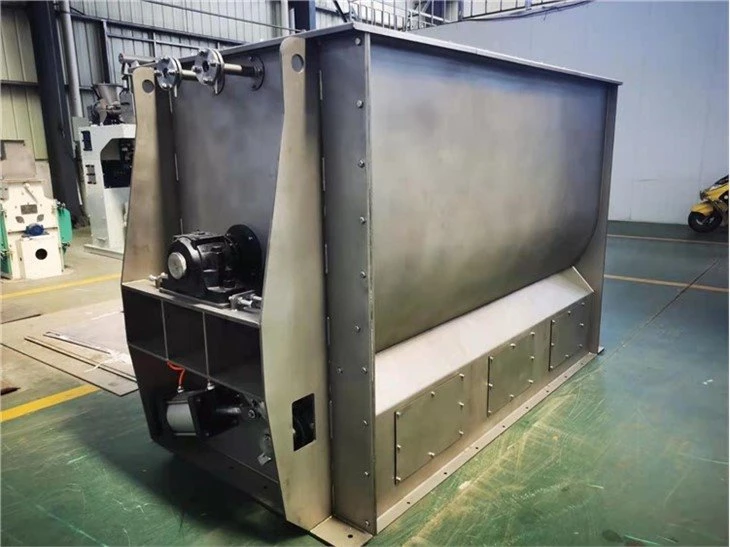
On the other hand, a double - shaft feed mill mixer features two parallel shafts with mixing paddles or arms. These shafts rotate in opposite directions, creating a more complex and efficient mixing action. Now, let's dig into the advantages of a double - shaft mixer over a single - shaft one.
1. Faster Mixing Time
One of the biggest perks of a double - shaft feed mill mixer is its ability to mix ingredients much faster than a single - shaft mixer. With two shafts rotating in opposite directions, the mixing paddles create a high - intensity mixing zone. The ingredients are constantly being pushed, pulled, and tumbled from one side of the mixer to the other. This rapid movement ensures that all the particles are evenly distributed in a shorter period.
For example, in a large - scale feed production facility, time is money. A single - shaft mixer might take 5 - 10 minutes to achieve a homogeneous mixture, while a double - shaft mixer can do the same job in just 2 - 3 minutes. This means you can increase your production output significantly, meeting the demands of your customers more efficiently.
2. Better Mixing Quality
When it comes to feed production, the quality of the mix is crucial. Animals need a balanced diet, and that means all the nutrients, vitamins, and minerals should be evenly distributed throughout the feed. A double - shaft mixer excels in this area.
The dual - shaft design creates a three - dimensional mixing pattern. The opposite rotation of the shafts causes the ingredients to cross paths multiple times, resulting in a more thorough and uniform blend. In a single - shaft mixer, there can be areas near the center or the edges of the mixer where the mixing is less effective, leading to pockets of unmixed or poorly mixed ingredients.
In a double - shaft mixer, these issues are minimized. Whether you're mixing fine powders, granular materials, or even liquids with solids, you can be confident that the final product will have a consistent composition. This is especially important for high - value feeds where precise nutrient levels are required.
3. Higher Capacity
Double - shaft feed mill mixers are generally designed to handle larger volumes of feed ingredients compared to single - shaft mixers. The efficient mixing action allows for a greater amount of material to be processed at once without sacrificing mixing quality.
If your feed production business is growing and you need to increase your batch size, a double - shaft mixer is the way to go. You can load more ingredients into the mixer, and it will still be able to mix them effectively in a reasonable amount of time. This scalability is a huge advantage for businesses looking to expand their operations.
4. Reduced Wear and Tear
Another advantage of double - shaft mixers is that they tend to have less wear and tear on the mixing components. The dual - shaft design distributes the mixing forces more evenly across the paddles and shafts. In a single - shaft mixer, the entire mixing load is concentrated on one shaft, which can lead to more stress and faster wear of the shaft and the attached mixing elements.
With a double - shaft mixer, the workload is shared between the two shafts, reducing the strain on each individual component. This means longer service life for your mixer, fewer maintenance requirements, and lower overall operating costs in the long run.
5. Flexibility in Mixing Different Materials
Double - shaft feed mill mixers are more versatile when it comes to mixing different types of materials. They can handle a wider range of particle sizes, densities, and viscosities. Whether you're mixing dry grains, moist ingredients, or even abrasive materials, a double - shaft mixer can adapt to the task.
Single - shaft mixers may struggle with certain types of materials, especially those that are difficult to mix or have a high moisture content. The double - shaft design provides a more aggressive and effective mixing action that can break up clumps and ensure a homogeneous mixture, regardless of the material properties.
Our Product Recommendations
At our company, we offer a range of high - quality double - shaft feed mill mixers. For instance, the SLHY Horizontal Mixer is a great option for medium - to large - scale feed production. It combines the advantages of a double - shaft design with a horizontal configuration, providing efficient and reliable mixing performance.
If you're looking for a more heavy - duty solution, our Twin - shaft Paddle Mixer is designed to handle even the toughest mixing tasks. With its robust construction and powerful mixing action, it can meet the demands of large - scale commercial feed mills.
And if you're in need of a pellet die for your feed production process, we also recommend checking out our Pellet Die Manufacturer section. We offer high - quality pellet dies that are designed to work seamlessly with our mixers, ensuring a smooth and efficient feed production process.

Conclusion
In conclusion, if you're in the market for a feed mill mixer, a double - shaft mixer offers several significant advantages over a single - shaft one. From faster mixing times and better mixing quality to higher capacity and reduced wear and tear, it's a smart investment for any feed production business.
If you're interested in learning more about our double - shaft feed mill mixers or have any questions about which mixer is right for your operation, don't hesitate to reach out. We're here to help you make the best decision for your business and ensure that you get the most out of your feed production process. Contact us today to start a discussion about your specific needs and let's see how we can work together to improve your feed production.
References
- Feed Mill Technology Handbook, various industry experts
- Research papers on feed mixing efficiency from agricultural universities