

As a well - established supplier of bucket elevators, I'm often asked about the unloading methods of these essential conveying machines. Bucket elevators are widely used in various industries, including agriculture, food processing, mining, and manufacturing, to vertically transport bulk materials from one level to another. Understanding the different unloading methods is crucial for ensuring efficient and reliable operation of the equipment.
Centrifugal Unloading
Centrifugal unloading is one of the most common methods used in bucket elevators. In this method, the buckets are attached to a belt or chain that rotates around a head pulley or sprocket at the top of the elevator. As the buckets reach the top of the elevator, the centrifugal force generated by the rotation of the belt or chain causes the material in the buckets to be thrown out through the discharge chute.
The principle behind centrifugal unloading is based on Newton's second law of motion. The force acting on the material in the bucket is given by the equation (F = ma), where (F) is the force, (m) is the mass of the material, and (a) is the acceleration. In the case of a bucket elevator, the acceleration is the centripetal acceleration, which is (a=\omega^{2}r), where (\omega) is the angular velocity of the belt or chain and (r) is the radius of the head pulley or sprocket.
Centrifugal unloading is suitable for handling free - flowing materials such as grains, seeds, and small pellets. The speed of the belt or chain is relatively high in centrifugal unloading, typically ranging from 1 to 2.5 meters per second. This high speed ensures that the material is quickly discharged from the buckets, minimizing the risk of material carry - back.
One of the advantages of centrifugal unloading is its high discharge efficiency. Since the material is thrown out of the buckets, it can be discharged over a relatively wide area, which is useful in applications where the material needs to be distributed evenly. However, centrifugal unloading may not be suitable for handling materials that are sticky or have a large particle size, as these materials may not be easily thrown out of the buckets.
Gravity Unloading
Gravity unloading is another common method used in bucket elevators. In this method, the buckets are designed in such a way that when they reach the top of the elevator, the material in the buckets simply falls out due to gravity. Gravity unloading is typically used for handling materials that are heavy, sticky, or have a large particle size.
The buckets used in gravity unloading are usually deeper and have a more open design compared to those used in centrifugal unloading. This allows the material to flow out of the buckets more easily under the influence of gravity. The speed of the belt or chain in a gravity - unloaded bucket elevator is relatively low, typically ranging from 0.5 to 1 meter per second.
The advantage of gravity unloading is its ability to handle a wide range of materials, including those that are difficult to discharge using centrifugal unloading. It also has a lower risk of material damage, as the material is not subjected to high - speed impacts during unloading. However, gravity unloading may have a lower discharge efficiency compared to centrifugal unloading, as the material falls out of the buckets more slowly.
Positive Discharge Unloading
Positive discharge unloading is a specialized method used for handling materials that require precise and controlled unloading. In this method, the buckets are equipped with a mechanical device, such as a flap or a gate, that opens at the top of the elevator to allow the material to be discharged.
Positive discharge unloading is commonly used in applications where the material needs to be transferred to a specific location or where the flow rate needs to be accurately controlled. For example, in the food processing industry, positive discharge unloading can be used to transfer ingredients to a mixer or a packaging machine.
The advantage of positive discharge unloading is its high level of control over the unloading process. It can ensure that the material is discharged in a consistent and accurate manner, which is important for maintaining product quality. However, positive discharge unloading systems are generally more complex and expensive compared to centrifugal or gravity unloading systems.
Factors Affecting Unloading Method Selection
When selecting an unloading method for a bucket elevator, several factors need to be considered.

Material Characteristics
The characteristics of the material being transported, such as its flowability, particle size, density, and stickiness, play a crucial role in determining the appropriate unloading method. As mentioned earlier, free - flowing materials are well - suited for centrifugal unloading, while sticky or large - particle materials may require gravity or positive discharge unloading.

Capacity Requirements
The required capacity of the bucket elevator also affects the unloading method selection. Centrifugal unloading is generally capable of higher capacities due to its high - speed operation. If a high - capacity elevator is needed, centrifugal unloading may be the preferred choice.
Installation Space
The available installation space can also influence the unloading method. Some unloading methods, such as centrifugal unloading, may require more space for the discharge chute to ensure proper material distribution. In contrast, gravity unloading may be more suitable for applications with limited space.
Our Bucket Elevator Offerings
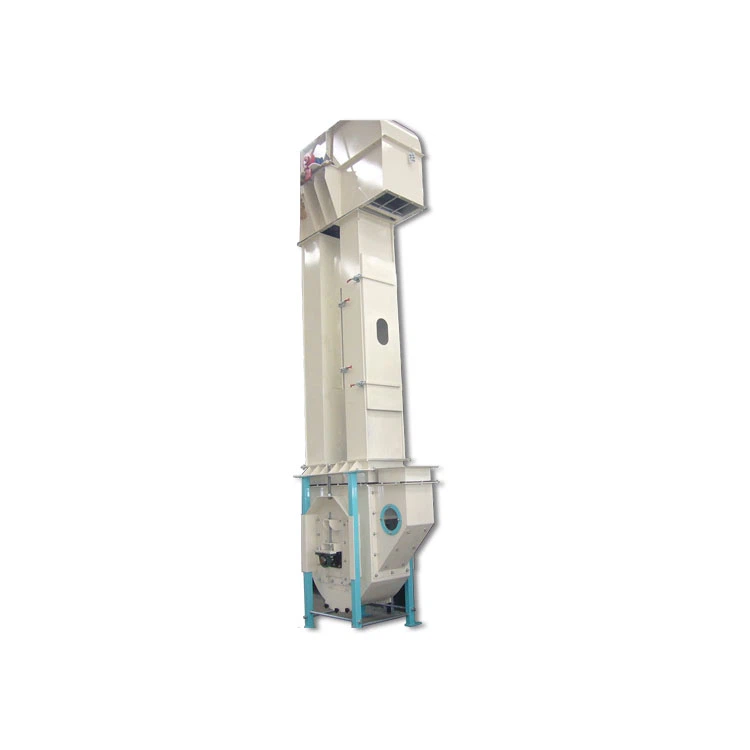
As a supplier, we offer a wide range of bucket elevators, including the [TDTG Bucket Elevator](/conveying - equipments/bucket - elevator/tdtg - bucket - elevator.html) and the [Flour Bucket Elevator](/conveying - equipments/bucket - elevator/flour - bucket - elevator.html). Our TDTG Bucket Elevator is designed for high - efficiency vertical transportation of various bulk materials. It can be equipped with different unloading methods based on the specific requirements of the application.
The Flour Bucket Elevator, on the other hand, is specifically designed for handling flour and other fine - powder materials. It features a special design to prevent material leakage and ensure smooth operation. We can customize the unloading method of this elevator to meet the needs of different flour processing plants.
Contact Us for Procurement
If you are in the market for a bucket elevator and need to discuss the appropriate unloading method for your application, we are here to help. Our team of experts has extensive experience in the design and selection of bucket elevators and can provide you with professional advice. Whether you need a centrifugal - unloaded elevator for handling grains or a gravity - unloaded elevator for sticky materials, we can offer a solution that meets your requirements.
Don't hesitate to contact us to start the procurement process and ensure that you get the best bucket elevator for your business.

References
- "Bulk Solids Handling and Storage" by Perry's Chemical Engineers' Handbook
- "Conveyor Equipment Manufacturers Association (CEMA) Standards" for bucket elevators