

When it comes to the feed manufacturing industry, the mixer stands as a cornerstone in ensuring the quality and uniformity of feed products. As a dedicated Feed Mill Mixer supplier, I've witnessed firsthand how the shape of a mixer can significantly impact the mixing process. In this blog, we'll explore the influence of different mixer shapes on feed mixing, along with real - world examples and their implications for feed production.
1. Horizontal Mixers
Horizontal mixers are one of the most commonly used types in feed mills. Their long, cylindrical shape provides several advantages that are crucial for an efficient mixing process.
1.1 Uniform Distribution
The horizontal design allows for a large surface area for the feed ingredients to spread out. As the paddles or other mixing elements rotate, the ingredients are continuously pushed and pulled along the length of the mixer. This results in a more uniform distribution of particles. For instance, in a Horizontal Mixer, when different grains, vitamins, and minerals are added, the horizontal movement ensures that every part of the mixture has an opportunity to come into contact with the other components.
1.2 Gentle Mixing
The shape of the horizontal mixer also promotes a relatively gentle mixing action. This is especially important when dealing with fragile ingredients such as certain vitamins or enzymes. The slow - moving paddles in a horizontal mixer can blend these delicate components without causing excessive breakage. This gentle mixing helps to maintain the integrity and functionality of the ingredients, which is essential for the nutritional value of the final feed product.
1.3 Continuous Operation
Horizontal mixers can be easily adapted for continuous operation. Their long shape allows for a smooth flow of ingredients in and out of the mixer. New ingredients can be added at one end while the mixed feed is discharged at the other. This continuous - flow design increases the overall production efficiency of the feed mill, making it a popular choice for large - scale operations.
2. Twin - shaft Paddle Mixers
Twin - shaft paddle mixers feature a unique shape where two parallel shafts are housed within a relatively wide horizontal chamber. This design offers distinct advantages in the mixing process.
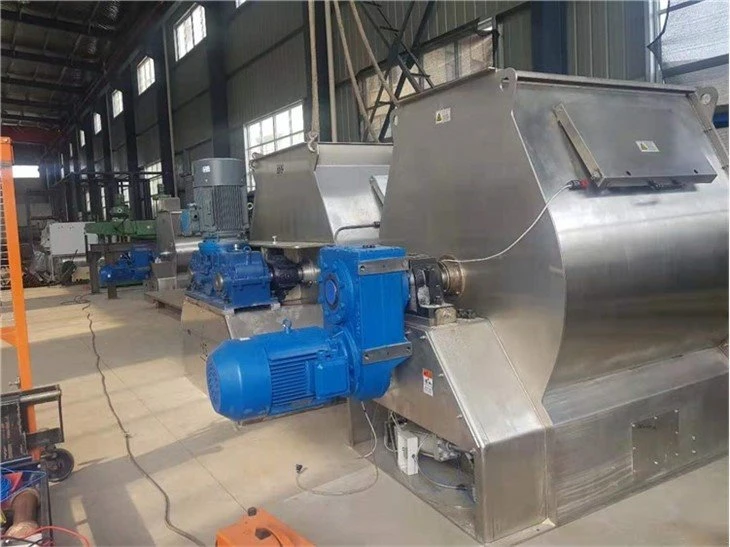

2.1 High - speed and Intense Mixing
The two shafts, each equipped with multiple paddles, rotate in opposite directions. This creates a high - speed and intense mixing environment. The counter - rotating action generates a strong shearing force that can quickly break up clumps and ensure thorough mixing of the ingredients. In a Twin - shaft Paddle Mixer, it can reduce the mixing time significantly compared to some other mixer types. This is beneficial for feed mills that need to produce large volumes of feed in a short period.
2.2 Homogeneous Blending
The shape of the twin - shaft paddle mixer promotes a three - dimensional mixing pattern. The ingredients are not only mixed along the horizontal axis but also vertically and laterally. This multi - directional mixing results in a highly homogeneous blend. For example, when mixing ingredients with different densities, such as light powders and heavy grains, the twin - shaft paddle mixer can ensure that all components are evenly distributed throughout the mixture, regardless of their weight.
3. SJHS Paddle Mixers
SJHS paddle mixers are another type of mixer with a specific shape designed to meet the requirements of feed production.
3.1 Flexibility in Mixing
The SJHS Paddle Mixer has a shape that allows for a high degree of flexibility in mixing. The paddles can be adjusted according to the specific needs of the ingredients being mixed. This means that whether you are mixing fine powders or coarser particles, the SJHS paddle mixer can be optimized to achieve the best mixing results.
3.2 Easy Cleaning
The shape of the SJHS paddle mixer also facilitates easy cleaning. Its design typically has fewer hard - to - reach areas, which is important for maintaining hygienic conditions in the feed mill. Residue buildup can lead to cross - contamination and affect the quality of future batches. With an SJHS paddle mixer, it is easier to clean the interior surfaces, ensuring the purity of each new batch of feed.
4. Impact on Energy Consumption
The shape of the mixer also has a direct impact on energy consumption. For example, horizontal mixers generally have lower energy requirements due to their relatively simple design and gentle mixing action. Their long, efficient flow path allows the mixer to move the ingredients with less power, which can result in significant cost savings over time.
On the other hand, twin - shaft paddle mixers, although they can achieve faster mixing, require more energy to operate. The high - speed rotation of the two shafts and the intense shearing action demand a more powerful motor. However, the reduced mixing time can offset the higher energy cost in terms of overall productivity.
5. Considerations for Feed Millers
When choosing a mixer based on its shape, feed millers need to take several factors into account.
5.1 Feed Ingredients
The nature of the feed ingredients is a key consideration. If the ingredients are fragile, a mixer with a gentle mixing action like a horizontal mixer might be more suitable. If the ingredients are likely to form clumps or have a wide range of densities, a twin - shaft paddle mixer could be a better choice.
5.2 Production Volume
The scale of the feed production also matters. For small - scale operations, a mixer with a simple shape and lower energy consumption might be sufficient. However, for large - scale feed mills, a mixer that can achieve high - speed and uniform mixing, such as a twin - shaft paddle mixer or an optimally designed SJHS paddle mixer, may be necessary to meet the production demands.
5.3 Budget
Budget is always a consideration. High - performance mixers with complex shapes and advanced features may come at a higher cost. Feed millers need to balance the purchasing cost with the long - term benefits of improved mixing quality and efficiency.
In conclusion, the shape of the mixer plays a crucial role in the feed mixing process. Different shapes offer different advantages in terms of mixing quality, efficiency, energy consumption, and ease of cleaning. As a Feed Mill Mixer supplier, we understand the importance of these factors and are committed to providing the most suitable mixer solutions for our customers. If you are in the feed manufacturing business and are looking for the right mixer for your operation, we encourage you to contact us for a detailed consultation. Our team of experts can help you select the best - fitting mixer based on your specific requirements.
References
- Upadhyay, R., & Mohan, R. (2017). Feed mixers: Principles, types, and performance. Journal of Feed Science and Technology, 3(1), 1 - 12.
- Singh, N., & Goswami, T. K. (2015). Unit operations in agricultural processing. CRC Press.