

Hey there! As a supplier of Feed Mill Mixers, I often get asked about how to calculate the mixing time for a specific feed formula in a feed mill mixer. It's a crucial aspect of the feed production process, and getting it right can significantly impact the quality of the final product. So, let's dive into it!
Understanding the Basics of Feed Mixing
Before we start calculating the mixing time, it's important to understand the basic principles of feed mixing. The goal of mixing in a feed mill is to achieve a homogeneous mixture of different ingredients. These ingredients can vary widely, from grains and protein sources to vitamins, minerals, and additives.
The homogeneity of the mixture is usually measured by the coefficient of variation (CV). A lower CV indicates a more uniform mixture. Most feed mills aim for a CV of less than 10% for optimal feed quality.
Factors Affecting Mixing Time
Several factors can influence the mixing time required for a specific feed formula. These include:
- Ingredient Characteristics: The physical properties of the ingredients, such as particle size, density, and shape, play a significant role. Ingredients with different particle sizes and densities tend to segregate more easily, requiring longer mixing times to achieve homogeneity.
- Mixer Type: Different types of mixers have different mixing efficiencies. For example, a Feed Mill Paddle Mixer and a Twin-shaft Paddle Mixer have different mixing mechanisms, which affect the time needed to mix the feed.
- Fill Level: The amount of feed loaded into the mixer, known as the fill level, can also impact mixing time. Overloading the mixer can reduce its effectiveness and increase the mixing time, while underfilling may not utilize the mixer's full capacity.
- Mixing Speed: The speed at which the mixer operates affects how quickly the ingredients are combined. However, too high a speed can cause ingredient degradation, while too low a speed may not provide sufficient mixing action.
Calculating the Mixing Time
Unfortunately, there's no one-size-fits-all formula for calculating the mixing time because of all the variables involved. However, there are some general steps and methods you can use as a starting point.
Step 1: Determine the Mixer's Capacity and Ideal Fill Level
First, you need to know the maximum capacity of your feed mill mixer and the recommended fill level. This information is usually provided by the mixer manufacturer. For example, if your mixer has a capacity of 1000 kg and the recommended fill level is 80%, you should aim to load 800 kg of feed into the mixer.
Step 2: Analyze the Ingredient Characteristics
Next, take a close look at the ingredients in your feed formula. Measure the particle size distribution, density, and shape of each ingredient. You can use a sieve analysis to determine the particle size distribution and a density meter to measure the density.
If you have ingredients with very different particle sizes or densities, you'll need to account for this when calculating the mixing time. For instance, if you're mixing fine powders with coarse grains, the fine powders may tend to stick to the sides of the mixer or form clumps, requiring a longer mixing time.

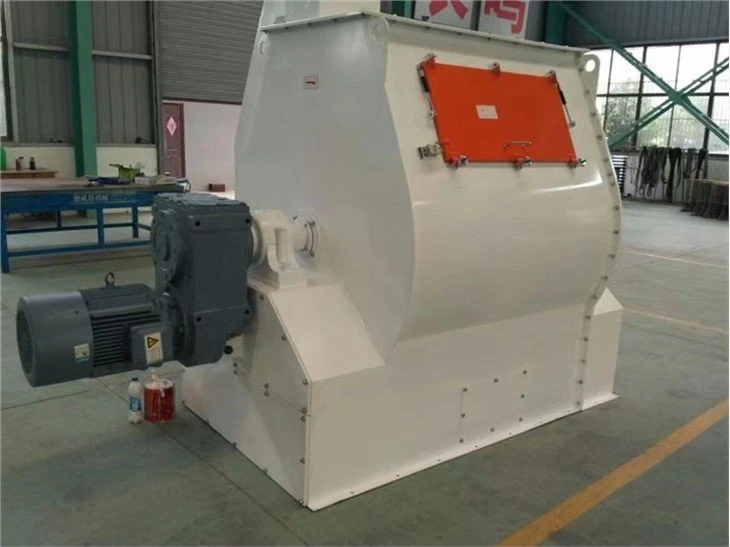
Step 3: Consider the Mixer Type
As mentioned earlier, different mixer types have different mixing efficiencies. Here's a brief overview of how some common feed mill mixers work and how they affect mixing time:
- Paddle Mixers: Feed Mill Paddle Mixers use paddles attached to a shaft to move the ingredients around the mixer. They are relatively gentle and can handle a wide range of ingredient types. However, they may require longer mixing times compared to some other mixer types.
- Twin-shaft Paddle Mixers: Twin-shaft Paddle Mixers have two counter-rotating shafts with paddles. This design provides more intense mixing action and can reduce the mixing time compared to single-shaft paddle mixers.
- Ribbon Mixers: Ribbon mixers use a helical ribbon agitator to move the ingredients in a spiral motion. They are efficient for mixing dry ingredients but may not be as effective for wet or sticky materials.
Step 4: Conduct a Pilot Test
To get a more accurate estimate of the mixing time for your specific feed formula, it's a good idea to conduct a pilot test. Here's how you can do it:
- Prepare a small batch of the feed formula using the recommended fill level of your mixer.
- Start the mixer and run it for a short period, say 1 minute.
- Take a sample of the mixture and analyze its homogeneity using a CV test. You can use a sample splitter and a laboratory analysis to determine the CV.
- Repeat steps 2 and 3, increasing the mixing time in small increments (e.g., 1 minute each time), until you achieve the desired CV (usually less than 10%).
The total mixing time at which you reach the desired CV is the estimated mixing time for your feed formula in that particular mixer.
Fine-tuning the Mixing Process
Once you've determined the initial mixing time, you may need to fine-tune the process over time. Here are some tips to help you optimize the mixing process:
- Regularly Monitor the Homogeneity: Take samples of the mixed feed regularly and analyze their CV to ensure that the mixing process remains consistent. If the CV starts to increase, it may indicate a problem with the mixer or the feed formula.
- Adjust the Mixing Speed: If the mixing time is too long or the ingredients are not mixing well, you may need to adjust the mixing speed. However, make sure to do this gradually and monitor the effect on the feed quality.
- Maintain the Mixer: Keep your feed mill mixer well-maintained to ensure its optimal performance. This includes cleaning the mixer regularly, checking the bearings and belts, and replacing any worn-out parts.
Importance of Pellet Dies in Feed Production
In addition to the mixing process, the quality of the Pellet Die Manufacturer also plays a crucial role in feed production. Pellet dies are used to shape the mixed feed into pellets, which are more convenient to handle and store.
A good pellet die should have the right hole size, depth, and shape to ensure that the pellets are of uniform size and quality. It should also be made of high-quality materials that can withstand the pressure and wear during the pelletizing process.
Conclusion
Calculating the mixing time for a specific feed formula in a feed mill mixer is not an exact science, but by understanding the factors that affect mixing time and following the steps outlined above, you can get a good estimate. Remember to conduct pilot tests, monitor the homogeneity of the mixed feed, and fine-tune the mixing process as needed.
If you're in the market for a high-quality feed mill mixer or need advice on feed mixing and pelletizing, we're here to help. Contact us to discuss your specific needs and let's work together to improve the efficiency and quality of your feed production process.
References
- "Feed Mixing Technology" by Feed Manufacturing Technology Institute
- "Principles of Feedpelleting" by Midwestern University Feed Technology Extension