

The initial temperature of a product can significantly influence the cooling process in a counterflow cooler. As a provider of high - quality counterflow coolers, I've witnessed firsthand how this factor plays a crucial role in the efficiency and effectiveness of the cooling operation. In this blog, we'll delve into the various impacts that the product's initial temperature has on the counterflow cooling process.
1. Heat Transfer Rate
One of the most immediate impacts of the product's initial temperature is on the heat transfer rate. According to the laws of thermodynamics, the greater the temperature difference between the hot product and the cooling medium (usually air in a counterflow cooler), the faster the heat transfer. When the product enters the counterflow cooler at a high initial temperature, there is a large thermal gradient between the product and the incoming cool air. This large gradient drives a more rapid transfer of heat from the product to the air.
For example, if we have two batches of feed pellets, one with an initial temperature of 90°C and the other at 60°C, the batch at 90°C will transfer heat to the cooling air at a much faster rate initially. In a counterflow cooler, the air and the product move in opposite directions. The cool air first comes into contact with the already - partially - cooled product at the discharge end and then moves towards the incoming hot product. A high - temperature product provides more driving force for heat transfer as the air moves upstream, allowing for a more efficient cooling process.
2. Cooling Time
The initial temperature of the product also affects the overall cooling time. A product with a higher initial temperature will generally require more time to reach the desired final temperature. In a counterflow cooler, the cooling time is an important parameter as it can impact the production capacity. If the cooling time is too long, the throughput of the cooler will be reduced.
Let's assume that the target final temperature for a feed pellet product is 30°C. A pellet with an initial temperature of 100°C will take longer to cool to 30°C compared to a pellet with an initial temperature of 70°C. This means that in a continuous - flow counterflow cooler, if the initial temperature of the incoming product is consistently high, the conveyor speed may need to be reduced to ensure that the product has enough time to cool adequately. This, in turn, can slow down the entire production line.
3. Energy Consumption
Energy consumption is another area where the product's initial temperature has a significant impact. A higher initial temperature means more heat needs to be removed from the product. To achieve this, the counterflow cooler may need to use more energy to supply a larger volume of cool air or to maintain a lower temperature of the cooling air.
In a counterflow cooler, fans are used to blow air through the product bed. When dealing with a high - temperature product, the fans may need to run at a higher speed or for a longer duration to provide sufficient air for heat transfer. Additionally, if the cooling air needs to be pre - cooled (for example, in a hot climate), more energy will be required to lower the air temperature to a level that can effectively cool the high - temperature product.
4. Product Quality
The initial temperature can also influence the quality of the final product. In the case of feed pellets, a very high initial temperature can cause moisture loss during the cooling process. If the product cools too quickly from a very high initial temperature, it may lead to surface cracking or a non - uniform moisture distribution within the pellet.
On the other hand, if the initial temperature is too low, the product may not be properly cooked or processed before entering the cooler, which can also affect its quality. For example, in a feed pellet production line, the pelleting process usually involves high - temperature steam injection to gelatinize the starch in the feed ingredients. If the initial temperature of the pellets leaving the pellet mill is too low, the starch may not be fully gelatinized, resulting in poor pellet quality.
5. Impact on Counterflow Cooler Design
The expected initial temperature of the product can also influence the design of the counterflow cooler. For products with a consistently high initial temperature, a larger cooler may be required to ensure sufficient cooling capacity. This may involve increasing the length of the cooler, the cross - sectional area of the product bed, or the number of air inlets and outlets.
A counterflow cooler designed for high - temperature products may also need to have better insulation to prevent heat loss to the surrounding environment. Additionally, the materials used in the construction of the cooler may need to be able to withstand higher temperatures without deformation or damage.

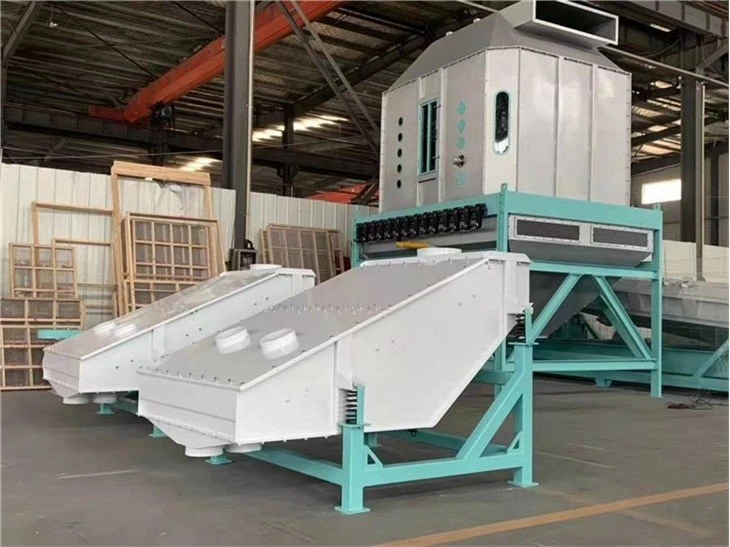
SKLN Counterflow Cooler and Counterflow Feed Pellet Cooler
Our company offers two excellent products that are designed to handle a wide range of initial product temperatures: the SKLN Counterflow Cooler and the Counterflow Feed Pellet Cooler. These coolers are engineered with advanced heat transfer technology to ensure efficient cooling regardless of the initial product temperature.
The SKLN Counterflow Cooler is known for its high - efficiency heat transfer design. It can effectively cool products with high initial temperatures while minimizing energy consumption. The Counterflow Feed Pellet Cooler, on the other hand, is specifically designed for the feed pellet industry. It can handle the unique requirements of feed pellets, such as maintaining the proper moisture content and pellet integrity during the cooling process.
Conclusion
In conclusion, the initial temperature of the product has a profound impact on the cooling process in a counterflow cooler. It affects the heat transfer rate, cooling time, energy consumption, product quality, and even the design of the cooler. As a counterflow cooler supplier, we understand these impacts and have developed products like the SKLN Counterflow Cooler and the Counterflow Feed Pellet Cooler to address the diverse needs of our customers.
If you are in the market for a counterflow cooler or need more information about how our products can handle different initial product temperatures, we invite you to contact us for a detailed discussion. Our team of experts is ready to assist you in finding the best cooling solution for your specific production requirements.
References
- Incropera, F. P., & DeWitt, D. P. (2002). Fundamentals of Heat and Mass Transfer. Wiley.
- Perry, R. H., & Green, D. W. (1997). Perry's Chemical Engineers' Handbook. McGraw - Hill.